
Support Services

Data Management
Smart data solutions for research: Call Centres, IoT and API integration, clinical databases, dashboards, AI metadata prep and scheduling.


Data Management
PHRU has an established data centre situated at two sites (Matlosana and Soweto) and provides data services to the PHRU and external partners.
In 2011, the PHRU started providing data services through a single data manager to the research projects situated in Matlosana. As the data demand increased, the PHRU opened the first centre in 2014. The center provides in-house data management support for clinical trials, experimental and observational studies. The following software is employed: REDCap, Medidata, Viedoc, ClinicalInk, OpenClinica, Firecrest Clinical, Exostar.
In 2022, PHRU recognized the need to consolidate its expanding data management capabilities, particularly as our innovative use of REDCap, and medical technologies for various research applications began to flourish, and in 2024 the PHRU DataLab was established.
The DataLab is essential in advancing research by uncovering new insights and addressing existing data gaps. It enhances PHRU’s bioinformatics capacity, aiming to match the level of innovation that our researchers strive for. The DataLab unifies data management, systems development and statistics into one cohesive unit, fostering creativity and efficiency, and allowing each expert to focus on their strengths.
We offer a comprehensive range of services, including:
– Database development and management
– Remote contacting of participants via our REDCap Call Centre
– Visit scheduling tools and reminders
– API integrations with lab partners and other data sources
– IoT device integrations
– Dashboarding and reporting
– Excel training
– Metadata collection, processing, and de-identification for AI projects (e.g., DICOM X-Rays, audio, general imagery)

Statistics
Statistical expertise for African research: study design, sample sizing, data analysis, machine learning, grant support, training, and AI-driven insights for diverse populations.



Statistics Support
When the PHRU was founded, it did not have an in-house statistician and depended on consultants and statisticians who worked with collaborative networks or other research groups.
As the PHRU grew, the need for in-house statistical support became apparent, and the PHRU now employs two full-time statisticians and offers an internship programme aligned with the National Research Foundation (NRF). The statistics department, in operation for more than 15 years, provides high-quality statistical expertise to PHRU-based researchers and collaborators, driving the research agenda of the University of the Witwatersrand, South Africa, and Africa.
The department’s first responsibility is to support principal investigators and colleagues within PHRU, offering services such as data analysis for writing reports to funders and manuscripts for peer-reviewed academic journals. Its second responsibility is to assist with sourcing grant funding, providing statistical input on study design, proposed statistical methods, and determining appropriate sample sizes for studies.
The department also aids collaborators locally and internationally with statistical analyses and employs cutting-edge methods, including statistical modelling, longitudinal data analysis, and data science/machine learning approaches. Responsibilities have included designing studies, data management, grant writing, manuscript writing, and capacity building through teaching, training, and mentoring early-career researchers.
The department mainly works on clinical trials, epidemiological studies, and socio-behavioural studies involving diverse populations such as infants, children, adolescents, adults, and key populations like female sex workers and their clients.
Looking ahead, there are plans to expand its capabilities to engage in more innovative research using modalities such as artificial intelligence to address public health concerns specific to African people, collaborating with a diverse array of partners, including higher learning institutions, research organizations, and industry partners.

Pharmacy
Clinical trial pharmacy services: compounding, cold-chain storage, aseptic prep, CTMS monitoring, tech-enabled adherence, and quality assurance for high-impact studies across diverse populations.

Pharmacy
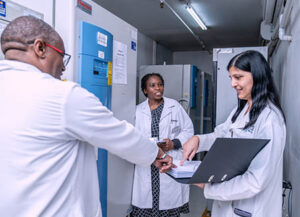
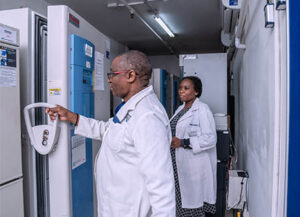
The PHRU pharmacies are located in Soweto, Matlosana and Aeroton. They provide a wide range of services to support and advance scientific discovery. From compounding medications for clinical trials and research studies, to managing drug storage and distribution, they play a crucial role in ensuring the safety and efficacy of investigational drugs.
Moreover, they provide expertise in medication management and quality assurance. With dedication to precision, accuracy, and innovation, the PHRU research pharmacy are indispensable partners in the pursuit of breakthrough treatments and advancements in healthcare.
Pharmacists and pharmacy assistants provide support to the various PHRU clinics. The wide range of medical grade storage equipment includes 2–8˚C refrigerators, -20˚C freezers and ultra-low freezers, which allows us to store investigational products across a wide range of temperatures. Biosafety cabinets allow us to prepare investigational products aseptically. The PHRU Pharmacies boasts a state-of-the-art Continuous Temperature Monitoring System (CTMS), Wi-Fi enabled air conditioners and back-up generators, all of which ensure our investigational products – both oral and injectable – are stored as per sponsor and manufacturers requirements.
Some of the trials completed included TPT (TB preventative therapy) and TB treatments (drug-resistant and multi-drug resistant), COVID-19 vaccines and oral treatments, influenza vaccines, and HIV treatment. The sheer numbers enrolled in some of these trials testify to the pharmacies’ capacity to work in synergy with clinical teams to achieve research targets. These interventional trials contributed to positive outcomes and endpoints, guiding national and international treatment guidelines.
Furthermore, the pharmacy has and continues to participate in paediatric, adult, blinded and double-blinded, and open-label studies, and works with clinical trial networks and sponsors.
Recently, the use of cutting-edge technology such as CMED, Encapsia, Wisepill, IRT sureAdhere and Suvoda has been managed from the pharmacy to improve participant adherence, provide remote monitoring and initiate intervention from site when required.
As the PHRU grew, the need for in-house statistical support became apparent, and the PHRU now employs two full-time statisticians and offers an internship programme aligned with the National Research Foundation (NRF). The statistics department, in operation for more than 15 years, provides high-quality statistical expertise to PHRU-based researchers and collaborators, driving the research agenda of the University of the Witwatersrand, South Africa, and Africa.
The department’s first responsibility is to support principal investigators and colleagues within PHRU, offering services such as data analysis for writing reports to funders and manuscripts for peer-reviewed academic journals. Its second responsibility is to assist with sourcing grant funding, providing statistical input on study design, proposed statistical methods, and determining appropriate sample sizes for studies.
The department also aids collaborators locally and internationally with statistical analyses and employs cutting-edge methods, including statistical modelling, longitudinal data analysis, and data science/machine learning approaches. Responsibilities have included designing studies, data management, grant writing, manuscript writing, and capacity building through teaching, training, and mentoring early-career researchers.
The department mainly works on clinical trials, epidemiological studies, and socio-behavioural studies involving diverse populations such as infants, children, adolescents, adults, and key populations like female sex workers and their clients.
Looking ahead, there are plans to expand its capabilities to engage in more innovative research using modalities such as artificial intelligence to address public health concerns specific to African people, collaborating with a diverse array of partners, including higher learning institutions, research organizations, and industry partners.

Regulatory
Regulatory support for ethical research: submissions, approvals, registry engagement, document prep, stakeholder communication, and compliance across clinical trials and biosafety protocols.

Regulatory
PHRU’s regulatory processes are designed to ensure compliance with ethical and regulatory standards, provide essential support to research sites, and maintain transparency through various registries and databases. This streamlined approach helps PHRU in maintaining its leadership and credibility in the field of public health research.
Responsibilities of the Regulatory Department:
The PHRU regulatory department handles communication and submissions to several key bodies:
– University of the Witwatersrand Human Research Ethics Committee (Wits HREC)
– University of the Witwatersrand Biobank Ethics Committee (BEC)
– University of the Witwatersrand Institutional Biosafety Committee (IBC)
– South African Health Products Regulatory Authority (SAHPRA)
– Department of Agriculture, Forestry and Fisheries (DAFF) for Genetically Modified Organisms (GMO)
– National Health Research Database (NHRD)
– South African Clinical Trials Registry (SACTR)
– Pan African Clinical Trials Registry (PACTR)
PHRU utilizes several registries and databases:
– South African National Clinical Trials Register (SANCTR): Provides updated information on clinical trials in South Africa, helping in monitoring and managing new clinical trials.
– Pan African Clinical Trials Registry (PACTR): A comprehensive database of clinical trials in Africa, facilitating the understanding of regional research patterns and identifying research gaps.
These registries play a crucial role in ensuring transparency, accessibility, and comprehensive management of clinical trials conducted by PHRU. The regulatory department facilitates PHRUs engagement with these registries and databases.
Additionally, the department provides essential services such as template provision, advice, guidance, cover letters, formatting, checking and finalizing submissions, providing regulatory files, and communicating with other sites and stakeholders. They also manage the submission and approval documents, supports the submissions for hospital and provincial approvals, regulatory fees, change of investigator forms, continuing reviews, and revised informed consent forms (ICFs).

Clinical Laboratory for Experimental and Analytical Research (CLEAR)
GCP-compliant lab offering PBMC processing, cryopreservation, LDMS tracking, IQA proficiency, and secure biostorage with SOP-driven quality control for clinical research.

Clinical Laboratory for Experimental and Analytical Research (CLEAR)
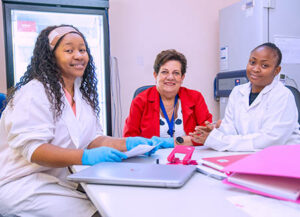
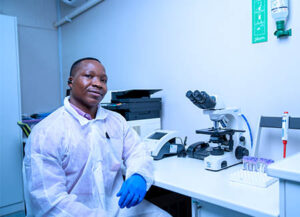
CLEAR is a recently established PHRU laboratory staffed with competently trained laboratory technicians, who are supervised by a registered HPCSA senior lab technician. They are GCP, GCLP and IATA trained.
The temperature-controlled lab is equipped with a certified biosafety cabinet (BCS hood), and a temperature-controlled -80°C freezer with a capacity of storing 10,000 samples is linked to backup generator power. The storage of reagents takes place in a temperature-controlled 2–8°C fridge.
Peripheral Blood Mononuclear cell (PBMC) samples are processed using an annually calibrated and serviced refrigerated centrifuge and manual counts are done under the microscope.
Samples are logged and labelled using the Laboratory Data Management System (LDMS) and cryopreserved and stored onsite, but are sent to collaborating clinical research laboratories monthly for long-term storage. These facilities have ultra-low freezers (-70°C to -80°C) with a capacity for 500,000 samples, and liquid nitrogen (-150°C to -196°C) for cryopreservation of viable PBMCs.
The laboratory takes part in an Internal Quality Assessment (IQA) PBMC proficiency programme with CLS every quarter. CLS actively participates in the Duke IQA programme and is a DAIDS-certified laboratory. Currently, laboratory active studies include the processing of pharmacokinetics plasma samples and storage of whole blood.
The laboratory has a standardised set of standard operating procedures that covers all lab activities like processing of samples, safety procedures, maintenance planners and quality control.